
The question of polynucleotides vs Profhilo has slowly become one of the most searched comparisons in London aesthetics this year. However, most patients who begin researching these two skin boosters are not really asking about either treatment. They are asking a simpler question: why does my skin not look like mine anymore?
The radiance has dimmed. The texture has changed. Makeup sits differently. Nothing is wrong, exactly. It is simply that the face in the mirror is reading tired when the person inside is not.
As a result, this is a skin-quality conversation, not a filler conversation. And it is the reason the polynucleotides vs Profhilo question keeps coming up. The honest answer, however, is that the choice is rarely one or the other. The more useful question is this: which treatment does what, when, and in what sequence for a particular skin. That is what this article sets out to explain.
First, what each treatment actually is
Profhilo: a bio-remodelling hyaluronic acid
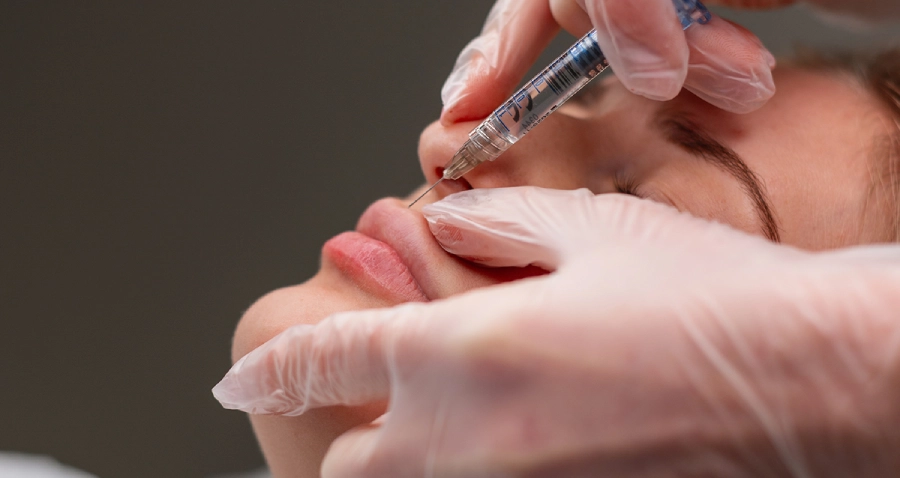
Profhilo is an injectable made from ultra-pure hyaluronic acid. It is not a filler in the volumising sense, because it does not reshape a cheekbone or define a jawline. Instead, once injected, it spreads through the tissue, drawing water into the skin and stimulating a gentle remodelling of elastin and collagen.
In essence, Profhilo delivers hydration and quiet firmness. This is the treatment most often recommended when skin has lost its bounce, when it reads dehydrated from across the room, or when the lower face or neck has started to look a little crepey. Results build over four to eight weeks and are typically maintained with two sessions a year.
Polynucleotides: regeneration at the cellular level
Polynucleotides are purified fragments of DNA, most commonly sourced from salmon or trout, that are highly biocompatible with human tissue. Once injected, they signal to the fibroblasts, the cells responsible for building collagen and elastin, to wake up and repair.
Whereas Profhilo hydrates and remodels, polynucleotides repair and regenerate. They are therefore the treatment of choice when skin is thinned, tired, damaged, or struggling to recover, around the eyes, on sun-compromised skin, or when a patient in their forties finds that the cream that worked for a decade has stopped working. Results build over six to twelve weeks as the skin rebuilds itself.
Polynucleotides vs Profhilo: The Key Differences at a Glance
In practice, the two treatments differ across six clinical dimensions. The comparison table below sets them out side by side.
| Profhilo | Polynucleotides | |
|---|---|---|
| What it is | Ultra-pure hyaluronic acid | Purified DNA fragments (PDRN) |
| Primary action | Hydration and bio-remodelling | Cellular repair and regeneration |
| Best for | Dehydrated, lax, crepey skin | Thin, tired, damaged, under-eye skin |
| Results show | From week 2 to 4 | From week 4 to 8 |
| Typical course | 2 sessions, 1 month apart | 3 sessions, 2 to 3 weeks apart |
| Maintenance | Twice a year | Twice a year |
The Beauty Script
Need Answers?
We are here to support you every step of the way – before, during, and after your visit
How the Polynucleotides vs Profhilo Decision Is Actually Made
In a medically-led setting, one of these treatments is rarely recommended in isolation for the patients who come in asking about skin boosters. Skin that has lost quality is usually struggling on more than one front at once. For instance, it may be dehydrated and thinned. It may be losing elasticity and also recovering from years of sun exposure.
Consequently, treating only one of those things gives a partial result, and partial results are how patients end up disappointed by aesthetics.
Consequently, treating only one of those things gives a partial result, and partial results are how patients end up disappointed by aesthetics.
A sequenced Script tends to look something like this:
- Repair first. Polynucleotides to wake up the fibroblasts and rebuild the quality of the skin from underneath.
- Remodel and hydrate second. Profhilo to bring water, bounce, and a quiet lift to tissue that has just been primed to respond.
- Maintain thoughtfully. A rhythm of seasonal top-ups, not a constant drip of treatment. Skin rewards patience.
Sequenced this way, the polynucleotides vs Profhilo debate largely dissolves. The two treatments do not compete. They compound. In fact, the Profhilo works better because the skin it is meeting is already more responsive. Meanwhile, the polynucleotides last longer because the tissue holding them is better hydrated. This is what a Script is: a plan, not a procedure.
When one treatment is enough on its own
Profhilo alone tends to be the right starting point for patients whose main concern is hydration, a loss of glow, or early laxity in the lower face and neck, and whose skin is otherwise healthy. It is also a beautiful pre-wedding or pre-event treatment when time is short.
Polynucleotides alone tend to be the right starting point for the under-eye area, which is almost never a tear-trough filler job the way patients often assume. Similarly, they are the preferred option for patients with thinned, compromised, or reactive skin where adding volume would be the wrong instinct entirely. When weighing polynucleotides vs Profhilo for skin that is recovering from prolonged sun damage, acne scarring, or previous over-treatment, polynucleotides win almost every time.
What this conversation looks like in a Beauty Script consultation
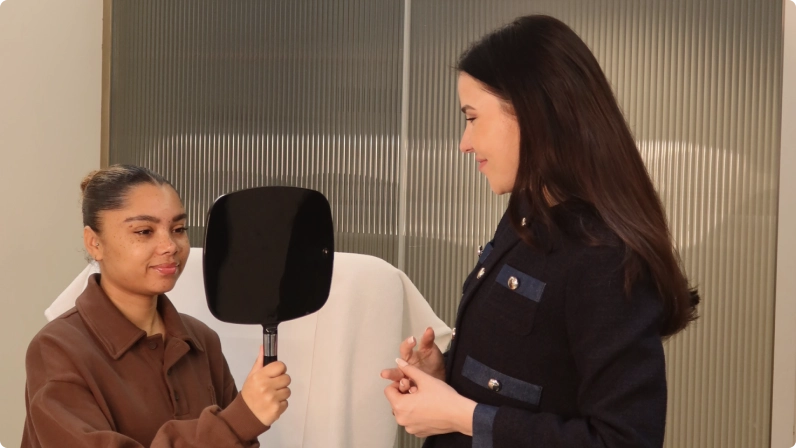
When a patient books a consultation at The Beauty Script asking about the polynucleotides vs Profhilo question, the conversation does not start with the treatments. It starts with the skin. Valentina assesses it across four dimensions, structure, volume, quality, and movement, and only then is there a conversation about what, if anything, to inject.
Sometimes the answer is polynucleotides. Sometimes it is Profhilo. Sometimes it is a sequenced Script using both. Occasionally it is neither, because the skin needs a season of better barrier care before an injectable will give its best result. That last answer is one patients rarely hear elsewhere. It is also, quite often, the most honest one.
Frequently asked questions
Is one safer than the other?
Both treatments have strong safety profiles when administered by a medically-trained prescriber using licensed product. The risk in aesthetics is almost never the molecule. It is the hand holding the needle and the assessment that came before it.
Will the results look done?
No. Neither of these treatments adds volume in the way dermal filler does. Patients typically report that their skin looks well, not different. That is the point.
How much does it cost at The Beauty Script?
Pricing is always given inside the consultation, once the skin has been assessed and a plan agreed. A single-session price for either treatment is not a figure that makes sense in isolation, because it rarely reflects the protocol a patient actually benefits from.
Can these treatments sit alongside anti-wrinkle injections or filler?
Usually yes, and often they work beautifully together. The timing matters. A good clinician will sequence them carefully rather than layering everything into a single appointment.